
What we discovered in 2026
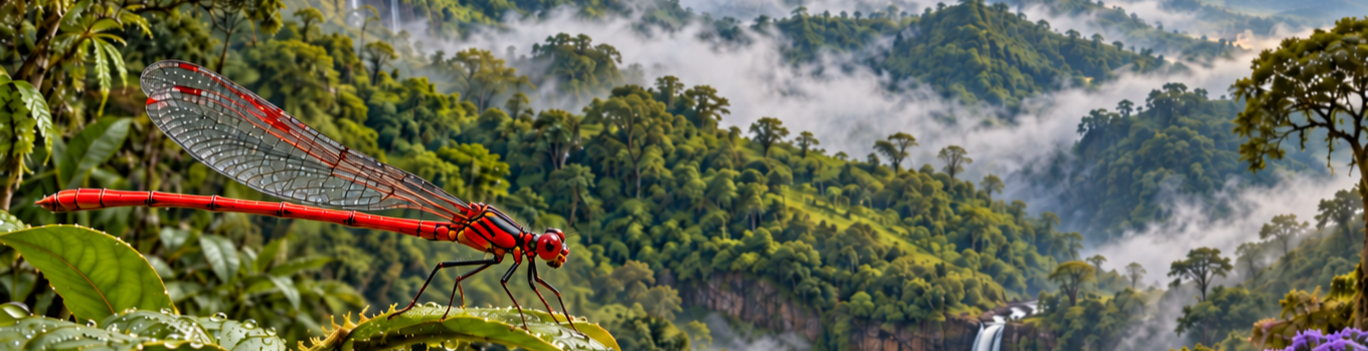
New species discovered
It is Anno 2026
And so far, over 20 new species of Odonata have been discovered and described this year - most of them in India or South America. The Western Ghats in particular, is a hotspot for dragonfly and damselfly biodiversity it seems.
The Western Ghats, also called the Sahyadri, are a 1,600-kilometer mountain range running parallel to the western coast of India. The exceptional diversity of species found there is due to a unique combination of geographical isolation, heavy monsoon rainfall, and dramatic variations in terrain.
The list of the 23 new dragonfly species described so far in 2026:
Hetaerina giselae — a jewelwing damselfly from Minas Gerais, Brazil, described using both morphology and COI data; published January 2026.
Lyriothemis keralensis — a new libellulid dragonfly from coastal Kerala, India, previously confused with L. acigastra.
Paragomphus sofiae — a new hooktail from Madagascar, February 2026.
Six new Calicnemia plus Coeliccia magna from northeast India, all in a single February paper.
Amazoneura submontana — a new damselfly from the Andean/Yungas region of Peru; the fourth species in the genus.
Three new hawkers from northeast India: Sarasaeschna dosdewaensis, S. nuboides and S. sigotaayo.
Pseudagrion yalomi — a new red-group damselfly from New Britain, Papua New Guinea.
Paragomphus matroka — another new Madagascar hooktail, from the islands’s eastern rainforest.
Mortonagrion santha — a new damselfly from the Andaman Islands i the Indian Ocean.
Drepanosticta minhanhiana — a new platystictid damselfly from Luzon, Philippines.
Amphigomphus puerensis — a new gomphid dragonfly from Yunnan, China.
Aeschnophlebia bidoupi — a new hawker from the Central Highlands of Vietnam, supported by morphology plus COI and ITS2 phylogenetics.
Lestes paloti — a new spreadwing damselfly from the Western Ghats of southern India.
Copera phanthanhhaii — (Indochinese long-legged damselfly) a new featherleg-type damselfly from Vietnam and Thailand, published in August. A male was collected from the town Đồng Hới in the province Quảng Bình, Vietnam.
Leucobasis puinave — described in August from eastern Colombia; particularly interesting because it is only the second known species of Leucobasis.
The story of Pseudagrion yalomi
Six decades ago, a Danish expedition was launched to the South Pacific Ocean, aiming to increase knowledge on insects and plants of the islands of the Phillipines, Solomon and Bismarck.
The expedition was carried over the seas by a wooden, gaff-rigged ketch known originally as Havet (the Ocean), built in Svendborg in the 1930s. Later, it was bought by a man called J Lauritzen who renamed the vessel Noona Dan. His company lent the Noona Dan to the expedition in 1961.
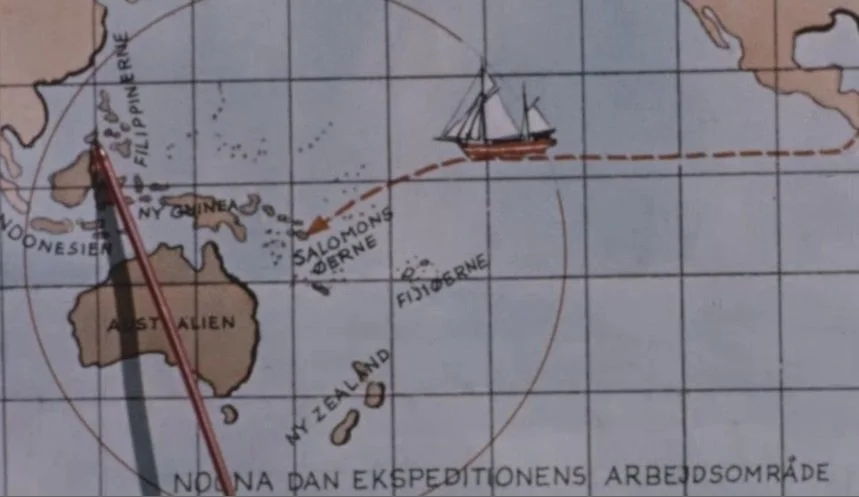
Noona-Dan expedition map

Noona-Dan expedition crew in 1961-62
Noona Dan arrived to the island of New Britainv (Papau New Guinea) in 1961, and the explorers came to the village of Yalom on May 8th. There is a short account of the activities at Yalo:
“Village (about 450 inhabitants) located in a large valley which on the west and south side is limited by lime stone cliffs rising to an altitude of 200-250 m. Primary forest still present on the cliffs, otherwise mixed vegetation. Various small streams were investigated (Freshwater Sts. 13-24, see Wolff 1966). Berlese samples Nos. 41-50, mixed vegetation. Malaise trap operated at the the margin of a small patch of primary forest, just above a stream. Robinson trap used in the village.”
In total 1 510 specimen of Odonata was collected during the entiriety of the Noona-Dan expedition, which is somewhat dwarfed by the staggering 37 500 butterflies and moths taken. All insects collected were brought to Denmark and there they remain in the Natural History Museum in Copenhagen (closed since 2022 for renovations).

Uring Uring, Palawan. Camp at the shore of Ipolote Bay. Malaise trap at a patch of shrub. Photo: Arvid Klémensen
Upon the return to Denmark, the vast insect collection of the Noona Dan was stored at the Zoological Museum, now part of the Natural History Museum in Copenhagen. And there it sat. For a great long while. And then, just recently, it was lent to Naturalis, the national research institute for biodiversity in The Netherlands.
In the paper that was published on the discovery of Pseudagrion yalomi it says:
“While sorting material at the Naturalis Biodiversity Center, a box of pinned specimens collected during the Danish Noona Dan Expedition (1961–1962) to the Philippines and New Guinea was discovered. Among this material were seven males of a species of the Pseudagrion red-group collected on the islands of New Britain. The study of these specimens proved them to belong to an undescribed species...”
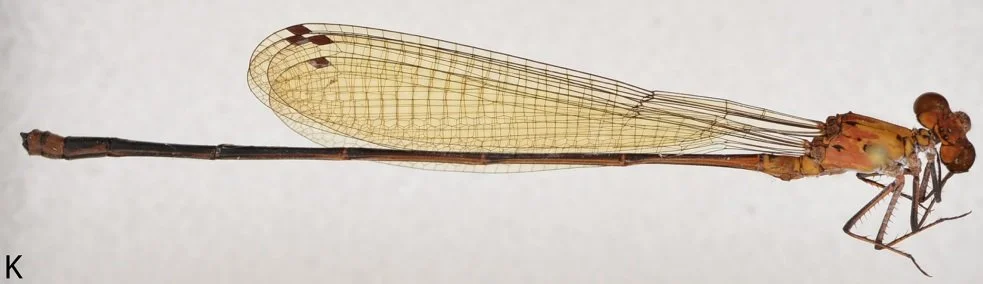
Images of the holotype of Pseudagrion yalomi (Hunter et al 2026)
For over 60 years, these little reddish damselflies lay unnoticed, and for far longer than that they have been fluttering around the hilltops of the Papua New Guinea archipelago. Isabella Hunter and her co-authors conclude their publication on the new damselfly with the statement:
“It seems likely that further fieldwork on islands such as New Ireland, Manus Island, or Tagula will lead to additional species being discovered”
In 2025, there were 6442 species of dragonflies and damselflies recognised. But with the eddition of discoveries made 2026, there are now over 6500. The number of new species added in 2026 is not an anomoly, previous years in the 2020s have seen an addition of approximately 30 species per year!
Currently, the little damselfly once caught in Papua New Guinea in 1962 does not have a common name: But P yalomi is a type of damselfly known as a sprite or a riverdamsel, it is red and scientifically named after the village Yalomi, hence I suggest to call it Yalomi red sprite.
Noona Dan
What happened to the ship that made the expedition possible? The crew specifically acknowledge the Noona Dan as “a very important part of the equipment” and describe how the ship made it possible to “carry more collecting equipment from place to place… preservation and the storing of the collected material was considerably facilitated”.
The Noona Dan was eventually sold to Germany to act as a training ship, re-named yet again to “Seute Deern” (sweet girl) and still sails with young people on training cruises in the Baltic Sea. In winter the ship is moored at Hamburg-Harburg.
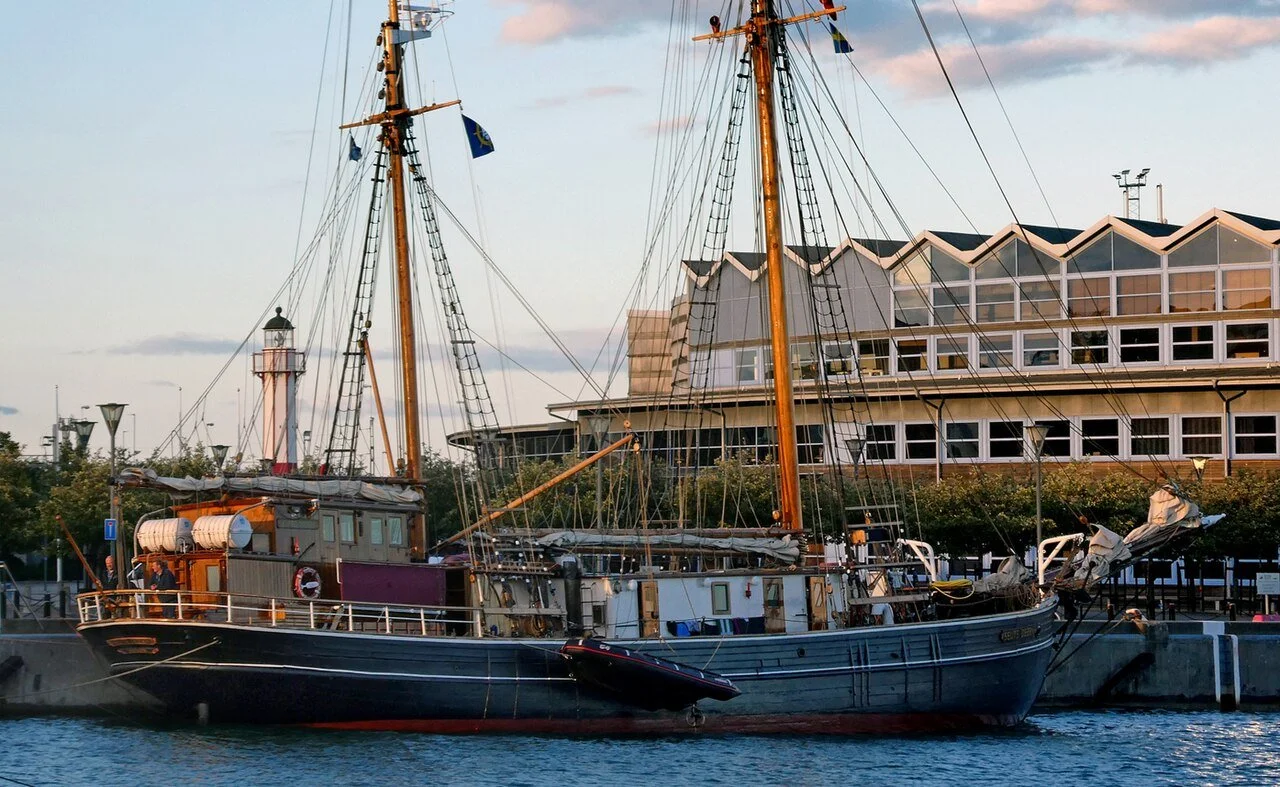
Noona Dan / Seute Deern on a visit to Ystad, southern Sweden, in 2020
References
Hunter, Sutherland, Bushnell, Scribner, Bybee & Kalkman (2026): A new species, Pseudagrion yalomi, of the Pseudagrion red-group from New Britain, Papua New Guinea (Zygoptera: Coenagrionidae). International Journal of Odonatology, 29, 81–86 doi:10.48156/1388.2026.1917382
Paulson, D., Schorr, M., Abbott, J., Bota-Sierra, C., Deliry, C., Dijkstra, K.-D. and Lozano, F. (Coordinators). (2026). World Odonata List. OdonataCentral, University of Alabama. Available at: https://www.odonatacentral.org/app/#/wol/. (Accessed: 10/13/2026).
Petersen, B. (1966). The Noona Dan Expedition, 1961–62. Insects and other land arthropods. Entomologiske Meddelelser, 34, 283–304

Interpretation of the Yalomi red sprite